Reading & Writing
- Learn more about how the author researched and wrote the text and how the illustrator illustrated this book.
- Read about the Incas
- Research: How did what Pizarro found at Cuzco influence what later happened in the northern part of the American continent?
- Research the kind of effect the gold had on Spain once it got there.
- Despite the fact that the Spainards had most of the Incas’ treasures and beautiful things, the Incas did give us a most precious gift.
- Read The Amazing Potato : a Story in Which the Incas, Conquistadors, Marie Antoinette, Thomas Jefferson, Wars, Famines, Immigrants, and French Fries all Play a Part. by Melton Meltzer (HarperCollins, 1992).
- Read another good book about the Incas, Gold: The True Story of Why People Search for It, Mine It, Trade It, Steal It, Mint It, Hoard It, Shape It, Wear It, Fight and Kill for It by Milton Meltzer (HarperCollins, 1993)
- Compare this version of the folktale with “The Search for the Magic Lake” by Genevieve Barlow in Latin American Folktales (Rand McNally, 1966).
- The Incas loved storytelling, and they told stories of the beginning of the world and of the hacha hacha, the eastern jungle where they said a great dragon snake lived. You can read one of their stories, for example, in From Out of the Ark: Stories from the World’s Religions by Anita Ganeri (Harcourt, 1996).
- Research to find out how these people influenced or who were part of the early Inca civilization.
- Father Bernabe Cobo
- Pedro de Cieza de Leon
- Pedro Sancho de la Hoz
- Tomas Garcilaso de la Vega
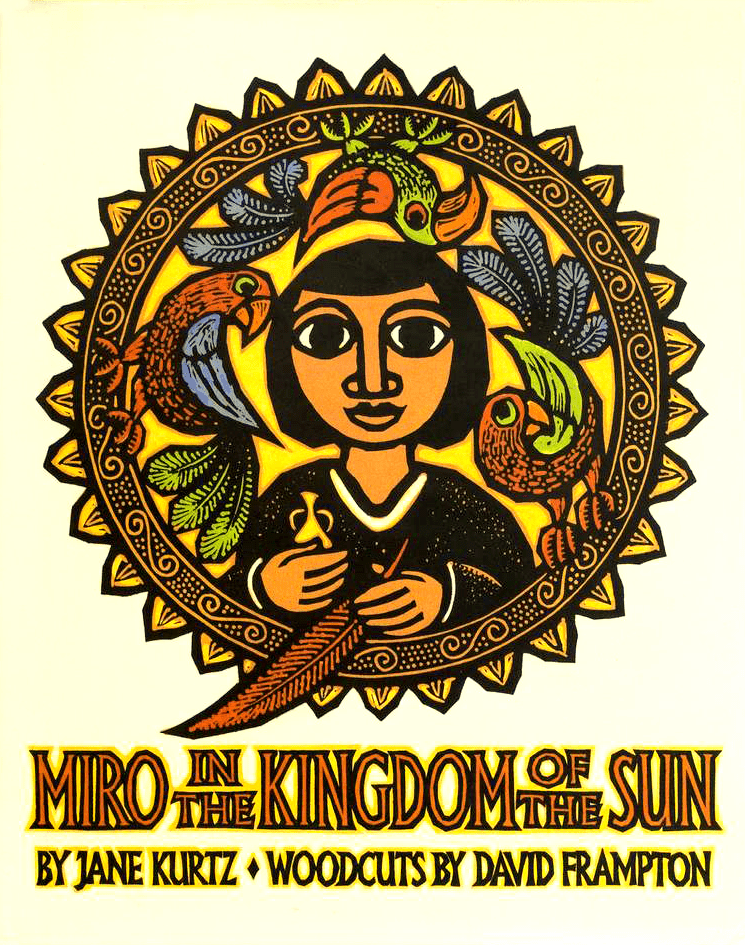
- Compare and contrast another book illustrated by David Frampton, Whaling Days (Houghton Mifflin) to Miro in the Kingdom of the Sun
- Take a close at some of the Inca symbols in these old pictures. You can carve one of the symbols onto styrofoam and then, using ink and a roller, create your own prints to illustrate Miro in the Kingdom of the Sun.
About the Illustrations
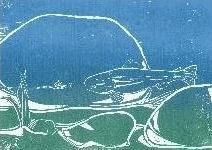 At the end of the 14th Century in Europe, artists began to use sharp tools to carve pictures in pieces of wood—first carving an outline with a sharp knife and then chiselling out the wood that was not going to be part of the picture. Ink was spread on the piece of wood and the wood block was pressed against paper.
Many artists today still explore the process of wood block carving. David Frampton used this old, old way of making pictures to do the illustrations for Miro in the Kingdom of the Sun. Jane’s son, David, created this fish picture for his high school art class by using the same process.
Further Reading
Some of the most helpful books because of their details on Inca daily life were:
- Lords of Cuzco: A History and Description of the Inca Poeple in their Final Days by Burr Cartwright Brundage (University of Oklahoma Press)
- Incas: Lords of Gold and Glory (Time Life Books)
- The Inca Empire and Its Andean Origins by Craig Morris and Adriana von Hagen (Abbeville Books)